
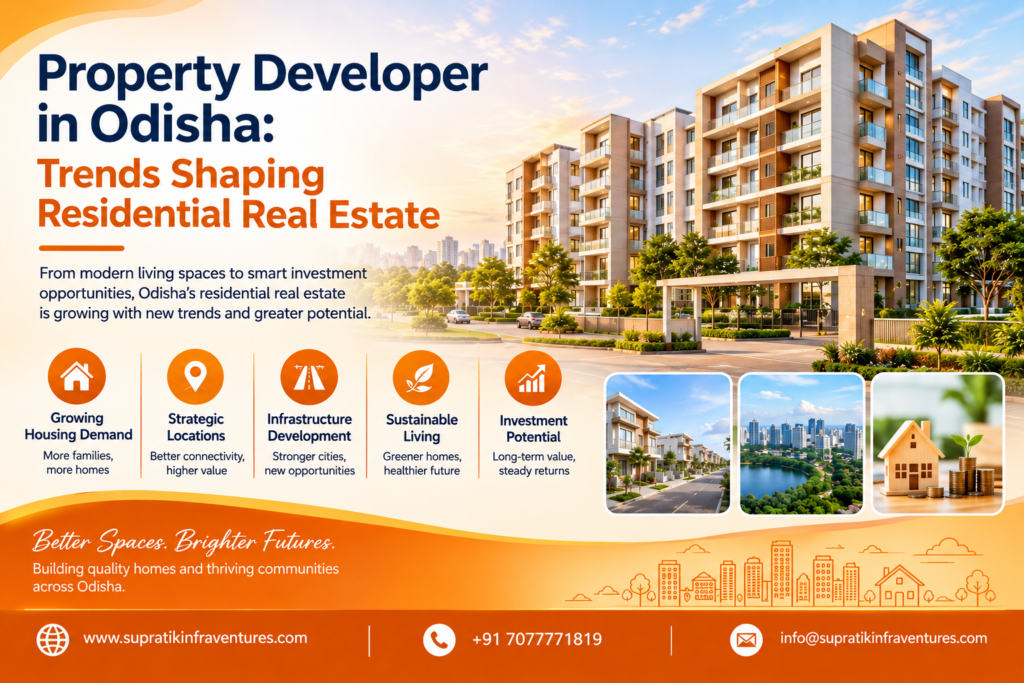
Odisha’s real estate sector is changing as cities expand, infrastructure improves, and more people look for homes that fit their daily needs. Residential property is no longer viewed only as a place to live. Buyers are also considering location, connectivity, construction quality, amenities, maintenance, security, and long-term value before making a decision.
Bhubaneswar continues to attract attention from homebuyers because of its growing urban infrastructure, employment opportunities, educational institutions, healthcare facilities, and expanding residential areas. Other cities and developing locations across Odisha are also seeing interest as buyers look beyond established neighbourhoods.
For buyers, choosing a Property Developer in Odisha involves more than comparing property prices. It is important to understand the developer’s project experience, construction approach, location planning, available facilities, documentation, and ability to deliver a practical residential environment.
The real estate market is also becoming more focused on efficient layouts, community living, open spaces, parking, security, and better use of available land. These factors can influence both the day-to-day experience of residents and the long-term usefulness of a property.
Residential Real Estate Trends Buyers Are Watching
Today’s homebuyers often have different expectations compared with earlier generations. While budget remains an important consideration, buyers are also looking for homes that provide convenience and support their lifestyle.
One noticeable trend is the growing interest in planned residential communities. Instead of purchasing an isolated property, buyers may prefer developments that provide shared facilities, access roads, parking, security arrangements, and common spaces.
Location continues to be one of the most important factors in property selection. A reasonably priced home may not provide the same practical value if it is far from workplaces, schools, hospitals, markets, or major transport routes.
Before selecting a residential property, buyers can consider:
- Distance from major roads and transportation facilities.
- Access to schools, hospitals, and everyday services.
- Quality of internal roads and common areas.
- Availability of parking.
- Water supply and drainage arrangements.
- Electricity and other essential infrastructure.
- Construction specifications and materials.
- Maintenance requirements.
- Legal and project-related documentation.
- Future development around the location.
Another trend is the demand for better space planning. Buyers are increasingly interested in layouts that make practical use of available floor area. Natural light, ventilation, storage, balconies, and room proportions can all influence how comfortable a home feels after occupancy.
These considerations are particularly relevant for families purchasing a property for long-term use. A home should work not only on the day of purchase but also as household needs change.
Choosing a Residential Project With Practical Value
Buying property is a major financial decision, so rushing into a purchase based only on advertisements or attractive images can create problems later. Buyers should spend time reviewing project information and understanding exactly what is being offered.
A developer’s project portfolio can provide useful context. Previous developments may help buyers understand the type of properties, layouts, locations, and community planning associated with the company.
For example, Supratik Infraventures has worked on residential developments in Odisha, including projects associated with Bhubaneswar and Balasore. A buyer researching a developer can review available project information and compare factors such as project scale, location, unit configuration, and development features.
It is also useful to prepare a checklist before visiting a property. This can prevent important details from being overlooked during a sales discussion.
A basic property checklist can include:
- Total property cost.
- Booking and payment structure.
- Carpet area and built-up area.
- Number of bedrooms and bathrooms.
- Parking arrangements.
- Floor and unit position.
- Construction specifications.
- Common-area facilities.
- Maintenance arrangements.
- Possession-related information.
- Applicable registration and documentation.
- Additional charges beyond the quoted price.
Buyers should also compare properties based on actual requirements rather than focusing only on the largest possible space. A smaller home in a suitable location may be more practical for one household, while another family may need additional rooms and storage.
Site visits are equally important. Photographs and digital brochures can provide an overview, but visiting the actual location can help buyers understand road access, surrounding development, neighbourhood conditions, and the general environment.
Sustainable and Community-Focused Housing
Sustainability is becoming a more relevant part of residential planning. It does not necessarily mean that every property needs expensive technology. Basic planning decisions can influence energy consumption, ventilation, water use, and maintenance requirements.
Homes with good natural light and ventilation can reduce dependence on artificial lighting and mechanical cooling during suitable weather conditions. Landscaping and open areas can also contribute to the overall environment of a residential development.
Some features buyers may look for include:
- Good natural ventilation.
- Efficient use of daylight.
- Proper rainwater management.
- Green or landscaped areas.
- Responsible waste-management arrangements.
- Durable construction materials.
- Practical water-management systems.
- Well-planned pedestrian areas.
- Adequate open spaces.
- Energy-efficient lighting in common areas.
Community planning is another important factor. Residential developments are shared environments, so the design of roads, parking, entrances, common spaces, and recreational areas can influence everyday living.
For families, nearby schools, healthcare services, markets, and transportation can also affect convenience. Working professionals may place greater importance on travel time and connectivity, while older residents may prioritise accessibility and essential services.
This is why there is no single definition of the perfect residential property. The right choice depends on household size, budget, work location, lifestyle, and long-term plans.
Conclusion
Odisha’s residential real estate sector is developing alongside changes in urban infrastructure, buyer expectations, and housing preferences. Homebuyers are increasingly looking for practical locations, efficient layouts, useful amenities, good connectivity, and residential communities that can support everyday life.
A property purchase should be approached with careful planning rather than based only on appearance or promotional claims. Buyers can compare locations, review project details, understand costs, inspect construction quality, and check documentation before making a commitment.
The growing focus on sustainable planning and community-oriented development also shows how residential projects are changing. Features such as natural ventilation, open spaces, efficient infrastructure, parking, security, and convenient access to essential services can make a meaningful difference to residents.
Ultimately, real estate decisions are personal and depend on individual requirements. A thoughtful comparison of location, budget, construction, facilities, documentation, and future needs can help buyers make a more informed choice.
FAQs
1. What should buyers check before purchasing a residential property?
Buyers should review the location, total cost, project documentation, construction specifications, amenities, parking, and payment terms. A site visit can also help confirm practical details.
2. Is location important when selecting a residential project?
Yes. Access to roads, workplaces, schools, hospitals, markets, and public services can influence everyday convenience and the long-term usefulness of a property.
3. What makes a residential project practical for families?
Good layouts, ventilation, storage, parking, security, open areas, and access to essential services can make a residential development more suitable for family living.
4. How can buyers learn more before making a property decision?
Buyers can review project information, visit the site, compare costs, examine available documentation, and use the developer’s Contact Us details to request specific information.
5. What should be included on a property website’s Faq page?
A useful Faq section can answer common questions about project locations, unit types, amenities, payment information, documentation, and site visits.
6. How can buyers compare different residential projects?
They can compare location, pricing, floor plans, construction specifications, amenities, connectivity, maintenance requirements, and project documentation before deciding.